
What Are You Looking For?

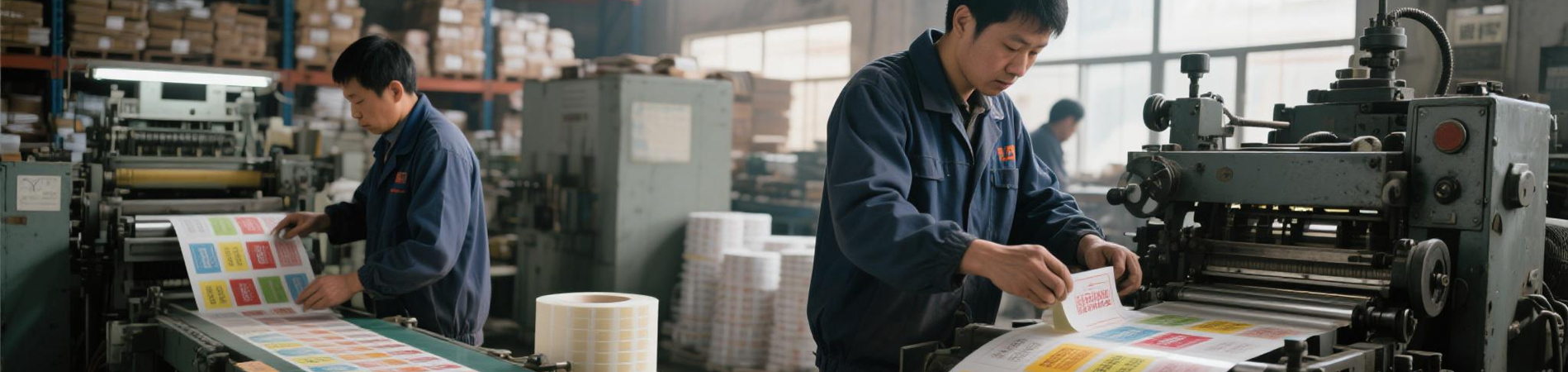
01 Edge Overflow
We all know that the adhesive layer in self-adhesive label materials has a certain degree of fluidity, which is greatly affected by temperature. Generally speaking, the higher the ambient temperature, the stronger the fluidity of the adhesive. Once the fluidity of the adhesive becomes stronger, it is very easy to cause the overflow phenomenon.When self-adhesive label materials are slit, due to the differences in the slitting knife edge and back, the end face of the slit self-adhesive material will have a certain degree of stickiness when touched by hand. If it is also affected by high temperatures, the sides of the self-adhesive label materials are more likely to have overflow problems.
Once self-adhesive label materials overflow, they are very difficult to deal with. Because the overflowed glue will stick to the material below, causing the material to fail to unwind and print normally. Therefore, when storing self-adhesive label materials or stacking unused self-adhesive label materials together, the sides of the self-adhesive label materials can be separated by release paper to avoid the materials sticking together and failing to separate due to adhesion. It should be noted that the silicone oil side of the release paper should be in contact with the end face of the material, and the stack should not be too high, otherwise it may also cause overflow problems.
In addition, before self-adhesive label materials are mounted on the machine for die-cutting and printing, an oily or neutral release agent can be sprayed on the material end face to reduce the residue of the adhesive that overflows from the end face on the rubber roller. If there is a serious overflow of self-adhesive label materials, they need to be processed again by trimming the edges before use.
02 Material Deformation
In the summer, we also often encounter the problem of loose or tight rolls of raw materials. This problem often occurs when raw materials are taken out of the warehouse after being stored for a period of time and used, and it is found that the roll is loose. In some severe cases, it cannot be used. This is because the humidity in the air in summer changes greatly. After the self-adhesive material loses water or absorbs water, the tension changes, resulting in loose or tight raw material rolls. Some materials, especially film self-adhesive materials, are also found to have a protruding core when used, which is also caused by this reason.Therefore, in summer, it is necessary to keep the minimum inventory of self-adhesive materials as much as possible, reduce the inventory cycle, and at the same time strengthen warehouse management to achieve “first in, first out”. Generally, the materials will not change significantly within 7 to 10 days after arrival, and the longest should not exceed 15 days. At the same time, the ambient temperature for storing self-adhesive label materials should be controlled between 18 and 28℃, and the humidity should be controlled between 40% and 60%. It should be particularly noted that self-adhesive label materials that have not been processed on the machine should not be opened in advance, and self-adhesive label materials that have not been used up or need to be processed in the next process after processing should be sealed and preserved in time.
03 Die-Cutting with Label Carrying and Overflow
When die-cutting self-adhesive materials in summer, if the ambient temperature is high, it is easy to have label carrying and overflow during waste removal, especially for hot-melt adhesive self-adhesive materials. This is because the hot-melt adhesive has a longer draw than water-based adhesive. During die-cutting and waste removal, it always feels like the adhesive layer has not been completely cut, with obvious draw and glue backflow, resulting in waste removal with label carrying and overflow problems.Therefore, when using hot-melt adhesive self-adhesive label materials for die-cutting and printing processing in summer, the temperature of the production site should be controlled at around 23℃ as much as possible. Waste can be removed directly after die-cutting, or the number of rollers the material passes through can be minimized to reduce glue backflow. At the same time, try to use die-cutting knives with a special coating on the surface during die-cutting. Especially for low-temperature adhesive and freezing adhesive self-adhesive label materials, the fluidity is particularly strong under high-temperature conditions, and there is generally a slight overflow phenomenon under normal processing conditions. The requirements for processing environment are higher. If necessary, the self-adhesive label materials can be frozen and then processed.
04 Label Bubbling and Wrinkling
Usually, after self-adhesive labels are printed, they will be wrapped with plastic bags or heat shrink film. In this way, the self-adhesive labels are basically isolated from the external environment. However, when summer comes and it often rains, the air humidity will suddenly increase after the rain. If the labels are applied at this time, they are very likely to absorb moisture from the air and expand, resulting in wrinkles or bubbling.Therefore, when storing self-adhesive label finished products in summer, it is necessary to pay attention. Try to open the packaging 24 hours before labeling and let the labels and the objects to be labeled stay in the same environment for 24 hours. This is conducive to balancing the humidity of the two and ensuring the quality of labeling. Especially when the object to be labeled is a corrugated cardboard box, this operation must be carried out to ensure the labeling effect.


 Lianqian Neighborhood, Siming District, Xiamen, Fujian,
China 361008
Lianqian Neighborhood, Siming District, Xiamen, Fujian,
China 361008 Tel: 0086-13395056294
 Email: sinitan@foxmail.com